Dog age chart
Dog years to human years for every age from 1 to 20, by adult size. The first year counts as 15 human years and the second as 9 more; after that big dogs age faster than small ones. Each age links to its own page with the life stage and what your dog needs then.
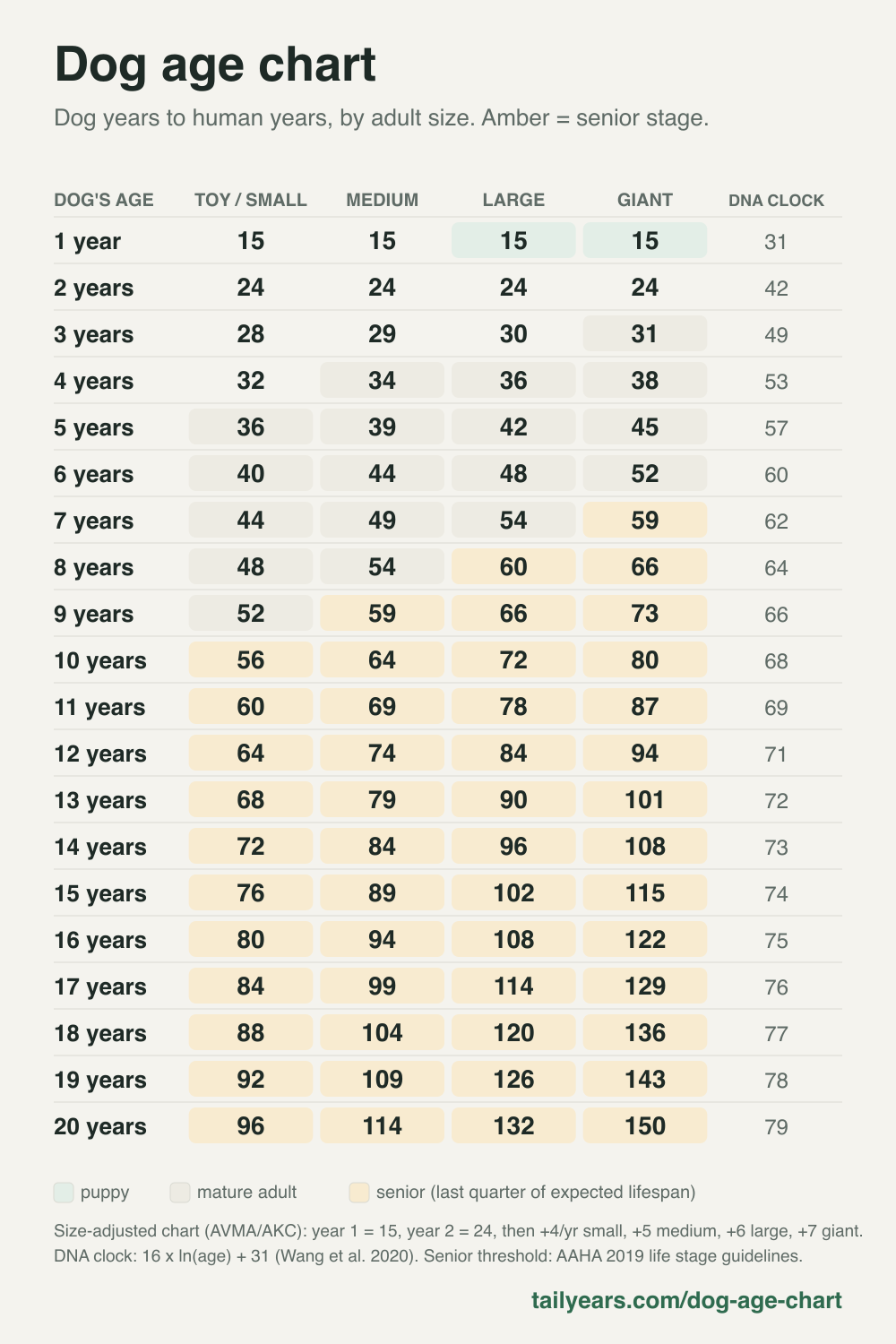
| Dog's age | Toy / small under 28 lb | Medium 28–55 lb | Large 55–100 lb | Giant over 100 lb | Epigenetic clock |
|---|---|---|---|---|---|
| 1 year | 15 | 15 | 15 | 15 | 31 |
| 2 years | 24 | 24 | 24 | 24 | 42 |
| 3 years | 28 | 29 | 30 | 31 | 49 |
| 4 years | 32 | 34 | 36 | 38 | 53 |
| 5 years | 36 | 39 | 42 | 45 | 57 |
| 6 years | 40 | 44 | 48 | 52 | 60 |
| 7 years | 44 | 49 | 54 | 59 | 62 |
| 8 years | 48 | 54 | 60 | 66 | 64 |
| 9 years | 52 | 59 | 66 | 73 | 66 |
| 10 years | 56 | 64 | 72 | 80 | 68 |
| 11 years | 60 | 69 | 78 | 87 | 69 |
| 12 years | 64 | 74 | 84 | 94 | 71 |
| 13 years | 68 | 79 | 90 | 101 | 72 |
| 14 years | 72 | 84 | 96 | 108 | 73 |
| 15 years | 76 | 89 | 102 | 115 | 74 |
| 16 years | 80 | 94 | 108 | 122 | 75 |
| 17 years | 84 | 99 | 114 | 129 | 76 |
| 18 years | 88 | 104 | 120 | 136 | 77 |
| 19 years | 92 | 109 | 126 | 143 | 78 |
| 20 years | 96 | 114 | 132 | 150 | 79 |
puppy young adult mature adult senior (last quarter of expected lifespan, AAHA 2019). Size-adjusted chart: +4 human years per dog year for toy and small dogs after age 2, +5 medium, +6 large, +7 giant. Epigenetic clock: 16 × ln(age) + 31 (Wang 2020).
Dog age chart by breed
The 30 most popular breeds, with the human-year equivalent at common ages and the age each becomes a senior. The senior threshold is the last quarter of the breed's expected lifespan, so a Great Dane is a senior at 6 while a Chihuahua reaches it at 11.
| Breed | Size | 1 yr | 3 yr | 5 yr | 7 yr | 10 yr | 12 yr | 15 yr | Senior from |
|---|---|---|---|---|---|---|---|---|---|
| Labrador Retriever | Large | 15 | 30 | 42 | 54 | 72 | 84 | 102 | 8.5 |
| German Shepherd Dog | Large | 15 | 30 | 42 | 54 | 72 | 84 | 102 | 6.5 |
| Golden Retriever | Large | 15 | 30 | 42 | 54 | 72 | 84 | 102 | 8.5 |
| French Bulldog | Small | 15 | 28 | 36 | 44 | 56 | 64 | 76 | 8.5 |
| Bulldog | Medium | 15 | 29 | 39 | 49 | 64 | 74 | 89 | 7 |
| Beagle | Medium | 15 | 29 | 39 | 49 | 64 | 74 | 89 | 9.5 |
| Poodle (Miniature) | Small | 15 | 28 | 36 | 44 | 56 | 64 | 76 | 10.5 |
| Poodle (Standard) | Large | 15 | 30 | 42 | 54 | 72 | 84 | 102 | 10.5 |
| Poodle (Toy) | Toy | 15 | 28 | 36 | 44 | 56 | 64 | 76 | 10.5 |
| Rottweiler | Large | 15 | 30 | 42 | 54 | 72 | 84 | 102 | 7 |
| German Shorthaired Pointer | Large | 15 | 30 | 42 | 54 | 72 | 84 | 102 | 8.5 |
| Yorkshire Terrier | Toy | 15 | 28 | 36 | 44 | 56 | 64 | 76 | 10 |
| Boxer | Large | 15 | 30 | 42 | 54 | 72 | 84 | 102 | 8.5 |
| Dachshund | Medium | 15 | 29 | 39 | 49 | 64 | 74 | 89 | 10.5 |
| Pembroke Welsh Corgi | Medium | 15 | 29 | 39 | 49 | 64 | 74 | 89 | 9.5 |
| Siberian Husky | Large | 15 | 30 | 42 | 54 | 72 | 84 | 102 | 10 |
| Great Dane | Giant | 15 | 31 | 45 | 59 | 80 | 94 | 115 | 6.5 |
| Australian Shepherd | Large | 15 | 30 | 42 | 54 | 72 | 84 | 102 | 10 |
| Doberman Pinscher | Large | 15 | 30 | 42 | 54 | 72 | 84 | 102 | 8.5 |
| Cavalier King Charles Spaniel | Small | 15 | 28 | 36 | 44 | 56 | 64 | 76 | 10 |
| Miniature Schnauzer | Small | 15 | 28 | 36 | 44 | 56 | 64 | 76 | 10 |
| Shih Tzu | Small | 15 | 28 | 36 | 44 | 56 | 64 | 76 | 10.5 |
| Boston Terrier | Small | 15 | 28 | 36 | 44 | 56 | 64 | 76 | 9 |
| Bernese Mountain Dog | Large | 15 | 30 | 42 | 54 | 72 | 84 | 102 | 6.5 |
| Pomeranian | Toy | 15 | 28 | 36 | 44 | 56 | 64 | 76 | 10.5 |
| Havanese | Small | 15 | 28 | 36 | 44 | 56 | 64 | 76 | 11.5 |
| Shetland Sheepdog | Small | 15 | 28 | 36 | 44 | 56 | 64 | 76 | 10 |
| Brittany | Medium | 15 | 29 | 39 | 49 | 64 | 74 | 89 | 10 |
| English Springer Spaniel | Medium | 15 | 29 | 39 | 49 | 64 | 74 | 89 | 10 |
| Pug | Small | 15 | 28 | 36 | 44 | 56 | 64 | 76 | 10.5 |
All 277 breeds: breed lifespans. Each breed page has its own prefilled age calculator.
Your dog's age
- Life stage nowmature adult
- Senior from about8 years
- Typical lifespan for this size or breed10–14 years
- Roughly the human equivalent ofa 36-year-old
Why the chart is shaped like this
Dogs reach sexual maturity in their first year and are fully adult by two, which is why year one is worth 15 human years and year two brings the total to 24. After that, the rate depends on size. In the 2024 UK study of 584,734 dogs, small breeds had a median lifespan of 12.7 years, medium 12.5 and large 11.9, and the shortest-lived breeds were all giants. Bigger dogs grow faster, and faster growth brings cancer, heart disease and joint failure sooner.
The epigenetic clock column comes from a 2020 study that compared DNA methylation patterns in Labradors with those of humans of known age. It says dogs age very fast early (a one-year-old is 31 in human terms) and slowly later (a 14-year-old is 73). The two methods disagree in the middle years; both agree that a dog is adult by two and old in the last quarter of its expected lifespan.
Using the chart
- Mixed breeds: use adult weight to pick the column. A 40 lb mix is medium.
- Puppies under one: scale year one: a 6-month-old puppy is roughly 7 to 8 in human terms.
- Senior care: when your dog crosses into the amber cells, switch to six-monthly vet visits with bloodwork. Start with the senior dog checklist.
Frequently asked questions
How do I read a dog age chart?
Find your dog's age in the first column and read across to the column for its adult size. The number is the age of a human at a similar point in life. A 5-year-old medium dog reads 39: an adult in the prime of life. A 10-year-old giant breed reads 80: a senior.
Is the "one dog year equals seven human years" rule accurate?
No. It came from dividing a human lifespan of about 70 by a dog lifespan of about 10 and it ignores how fast dogs mature. A one-year-old dog is closer to a 15-year-old human, and after two the pace depends on size: about 4 human years per dog year for small breeds and 7 for giants.
Which dog age chart is the most accurate?
None is a measurement. The size-adjusted chart on this page follows the AVMA and AKC approach and matches how vets stage dogs (adult by two, senior in the last quarter of expected lifespan). The 2020 epigenetic clock (16 × ln(age) + 31) is based on DNA methylation in Labradors and is a useful second opinion that ages dogs faster early and slower later.
How old is a 10-year-old dog in human years?
About 56 for a toy or small dog, 64 for a medium dog, 72 for a large dog and 80 for a giant breed on the size-adjusted chart. The epigenetic clock gives 68 for all sizes.
When does a dog become a senior?
In the last quarter of its expected lifespan (AAHA 2019): about 6 to 7 years for giants, 8 for large breeds, 9 for medium and 10 to 11 for small breeds. The breed table above shows the threshold for popular breeds.
Can I share or print this chart?
Yes. The chart image is free to use on your website, in a clinic or on social media with a link back to tailyears.com. The embeddable calculator updates itself when the science does.
Sources
- Wang T, Ma J, Hogan AN, et al. Quantitative translation of dog-to-human aging by conserved remodeling of the DNA methylome. Cell Systems. 2020;11(2):176-185. doi.org/10.1016/j.cels.2020.06.006
- Creevy KE, Grady J, Little SE, et al. 2019 AAHA Canine Life Stage Guidelines. Journal of the American Animal Hospital Association. 2019;55(6):267-290. www.aaha.org/resources/life-stage-canine-2019/
- McMillan KM, Bielby J, Williams CL, Upjohn MM, Casey RA, Christley RM. Longevity of companion dog breeds: those at risk from early death. Scientific Reports. 2024;14:531. doi.org/10.1038/s41598-023-50458-w
- American Veterinary Medical Association. Senior pets: how old is old? www.avma.org/resources-tools/pet-owners/petcare/senior-pets